
Most companies begin preparing for a raise when they start speaking to investors. By then, the questions that shape valuation have already been answered by the business itself: how reliable its numbers are, how decisions get made, and whether the management team can carry the next stage of growth.
Investors price the evidence behind a pitch deck, and that evidence takes time to build. We advise clients to plan for eighteen months of preparation before a raise, and to treat that period as a programme of work with its own milestones.
What investors are assessing
Behind every term sheet sits one question: can this business absorb capital and convert it into growth predictably? Diligence teams test that question in four places.
- Quality of earnings. Are the numbers consistent, reconciled and explainable, month by month?
- Governance. Does the business have a functioning board, clear decision rights and controls that work without the founder in the room?
- Management depth. Are the critical roles filled by people investors can back, with a plan for succession?
- Use of proceeds. Is there a clear, costed link between the capital requested and the growth it will produce?
Three things that take longer than founders expect
In our experience, the work that delays a raise sits in the foundations underneath the deck and the model.
A clean financial history
Investors will want two to three years of management accounts that reconcile to audited statements. Restating past periods, closing gaps in record-keeping and agreeing accounting policies with auditors can take two full reporting cycles.
Governance that works
A board that meets on a regular rhythm, reviews a consistent management pack and holds the executive team to account is hard to assemble in a hurry. Its track record is part of what investors assess.
A team investors can underwrite
If finance, operations or commercial leadership still depends on the founder, investors will discount for that risk. Recruiting and embedding senior hires can take the better part of a year.
Capital amplifies whatever is already in the business. Readiness makes sure that is worth amplifying.
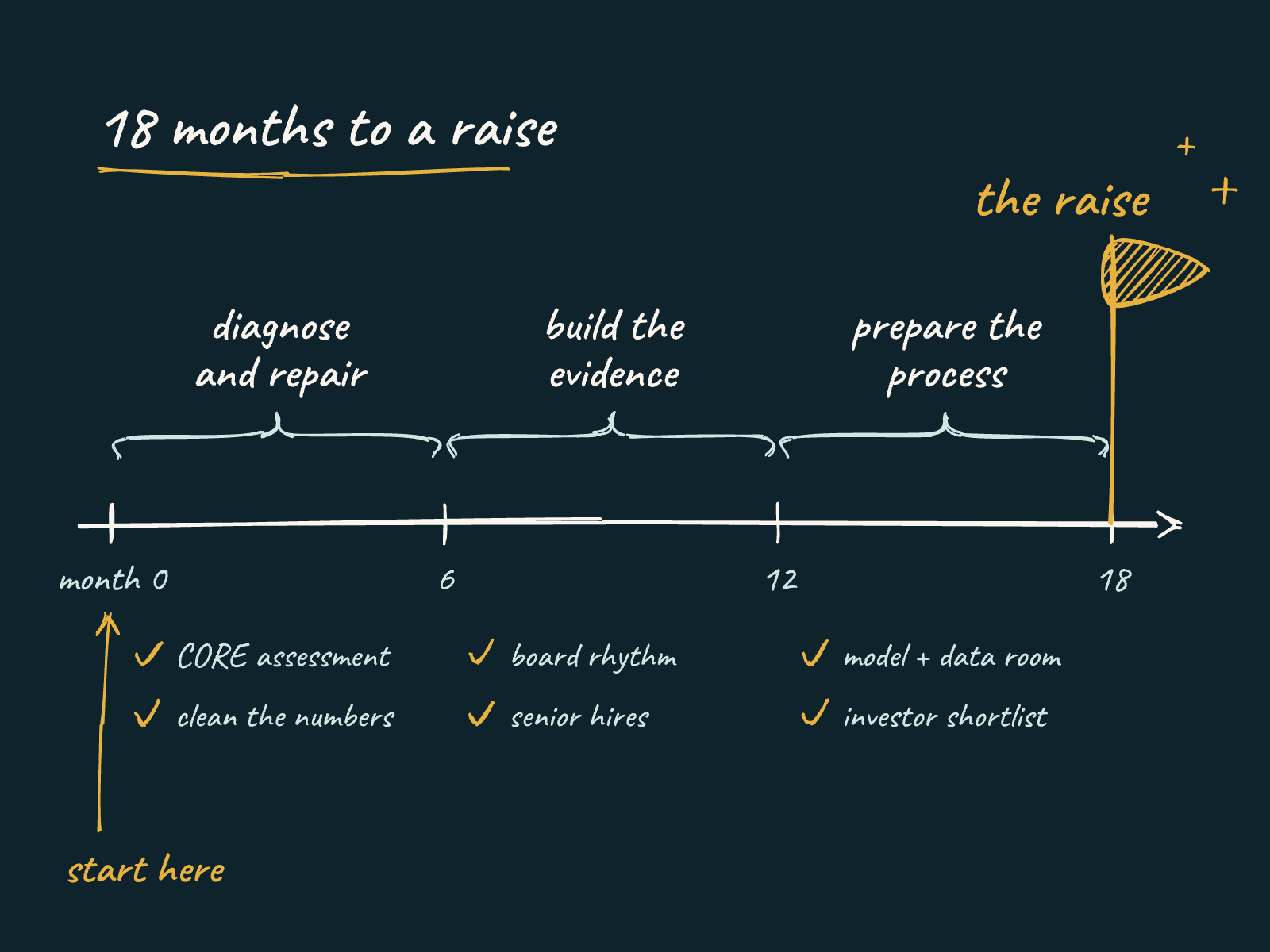
An eighteen-month readiness plan
We structure readiness in three phases. Each one ends with a clear test of progress.
- Months 1 to 6: diagnose and repair. Assess the business against the CORE Framework, close gaps in financial reporting, and set up the board and management reporting rhythm.
- Months 7 to 12: build the evidence. Run the business on the new operating model, hire into critical roles, and accumulate two or more quarters of clean, board-reviewed results.
- Months 13 to 18: prepare the process. Build the investor-grade financial model, information memorandum and data room, and shortlist investors whose mandate fits the business.
The readiness checklist
- Three years of management accounts, reconciled to audited statements
- A board or advisory board that meets at least quarterly
- Documented decision rights and delegated authorities
- Finance, operations and commercial roles led by people other than the founder
- A costed use of proceeds linked to revenue growth
- A data room structured to the standard of institutional diligence
How we assess readiness
Every readiness engagement at Kimani begins with a CORE assessment. We score the business on Organisation, Resources and Execution, and on how well the three align. The result is a prioritised plan that shows what needs to be fixed, and in what order, before capital is sought.
Where to begin
Start with a candid view of the foundations. If a diligence team arrived next month, which questions would be hardest to answer? That list is the beginning of your readiness plan. The earlier it is written, the more options the business will have when it is time to raise.